THE LAST BOOK
To live...!
A book intended to end itself.
PrologueThe Book That Wants to End
This is a book with one ambition: to end.
Not to end on the last page. To end in you.
It does not want to improve your Life. It does not hand you a meaning. It does not swap one belief for a newer one. Books have done that for five thousand years, and heads have only grown heavier.
This book wants to smooth things.
A human head carries an enormous cargo. Names. Rules. Morals. Gods. Pasts. Futures. Ideals. Fears. Definitions. Hopes. Almost none of it was chosen. It was loaded before you were old enough to see the loading.
Then you spent years calling the cargo "myself."
The great human difficulty is not learning. It is unlearning.
This book is not a manual for unlearning. A manual would only be one more thing to carry.
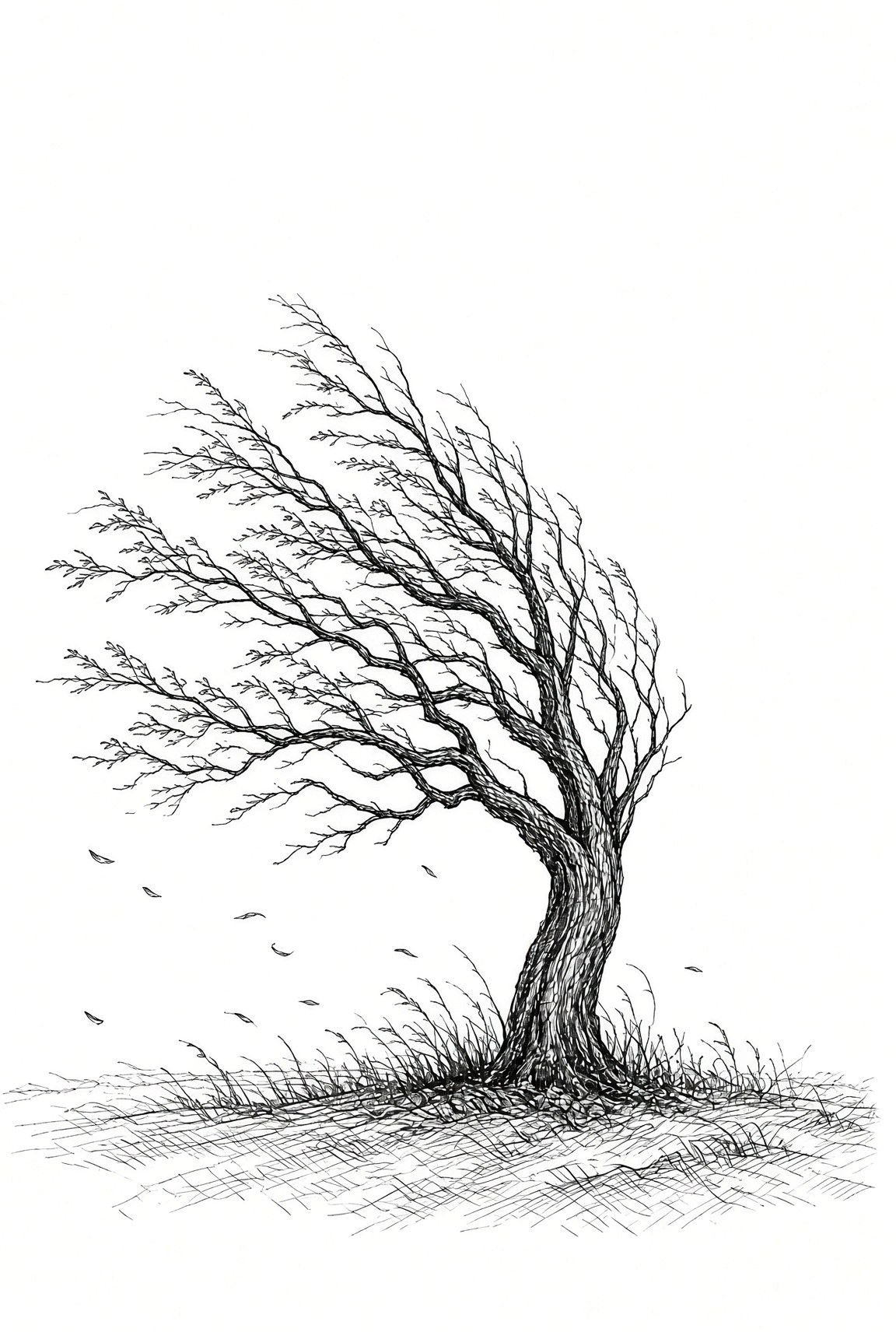
It is a tree.
A big tree standing in the wind.
The wind blows. The tree does not argue. It stands, and behind it, things settle.
When the last page comes, there should be less in you. Not more.
If the book does its work, you will not need to remember it.
You may even stop reading.
That would be the right ending.
The book ends. Everything becomes Life.
IThe Goat Says: Grass
Ask a goat what the world is.
Grass.
That is the complete philosophy. The goat eats. Then it rests. Nothing in the goat is waiting for an explanation.
The goat does not ask whether grass is meaningful. It does not decide whether eating is sacred. It does not need a definition of happiness before lying down in the sun.
It lives.
This sounds simple because it is simple. Humans have made simplicity suspicious.
Between ourselves and what is happening, we have packed language. Language is useful. It tells another person where the water is. It warns about fire. It lets a child call its mother.
Then language keeps growing.
Words acquire histories. Histories acquire rules. Rules become institutions. Institutions become cultures. Cultures become identities. Identities become things people die defending.
A sound becomes a wall. The wall becomes real enough to kill for.
The goat never built the wall.
There is nothing wrong with language. The trouble starts when the word is mistaken for the thing.
Grass is grass. The word grass feeds no one.
The word Life is not Life.
The word freedom is not freedom.
The word silence — we will come to that one. It is emptier than the rest.
And the word pure?
I don't have that word.
That may be one of the cleanest sentences a human can say. Not because language failed. Because sometimes there is nothing to put there — and an honest head leaves the spot empty.
One more wall can fall here: "real" and "unreal." The grain, or the flower it becomes — which is more real? The question is broken. Call one thing real, and you have just invented the unreal. Nature never made that split. A mouth did.
IIBefore the Words
A child arrives before the library.
Before religion. Before morality. Before nationality. Before beauty. Before success and failure. Before the story of who it must become.
Then the books begin.
Not paper books. People are books. Parents are books. Teachers, neighbors, screens, customs, punishments, rewards — all books. The child reads them without knowing that reading has started.
Is a child before language closer to truth? Of course. Not from secret wisdom — from empty shelves.
The fear of death arrives this way, early. Not as a discovery — as an atmosphere. I saw it before I was two. A face changes. A voice drops. A body disappears, and the adults perform their fear. Later, the same fear sits inside the language itself, in every phrase the culture built around dying.
I was not born afraid of death. It was handed to me. I have watched it handed to others — always handed, never grown.
God arrives the same way. For me, the idea of God was immense from thirteen to twenty-five. It filled every room it entered.
Then came books of another kind. Then watching. Years of watching Life do what it does.
Around forty, everything stood clear.
The first thing I consciously unbelieved was the floor itself: the feeling that we live at the bottom of things. We do not. The earth is under our feet, and everything else is up. Open. Nobody is stacked on top of us.
Inherited thought works exactly like that assumption. It becomes invisible. A man can defend an idea for forty years without noticing it was placed in him before he could finish a short sentence.
This is not an accusation against parents. They were loaded too. So were theirs. Culture passes itself forward through human mouths.
What ruins children is nothing exotic. It is the passed-down culture — learned, then handed over. I was ruined at a few years old, like everyone.
One day the grown child surveys the contents of his own head and says: I.
How much of it is I?
IIIThe Great Inventory
Take the big words out and look at them one by one. In daylight. Not to attack them. To weigh them.
God. Weighed already, by history. Humanity has worshipped thousands of gods, each with temples, offerings, and believers who were completely certain. The certainty was total; the gods went anyway.
The afterlife, the before-life. The two most useless things humans collectively agree as important. Some hundred billion people have lived and died. Confirmed reports back: zero. Yet whole civilizations organize their weeks around the after and the before, while the middle — the only part actually happening — waits.
Love. Love is hope. Why hope, when nothing is missing?
Beauty. Made up, of course. Watch how cultures wear it: one performs it as art, another manufactures it on an assembly line. If beauty were a fact, it would not need a factory.
Happiness. A made-up goal. Nothing in the field has ever chased it, and nothing in the field has missed it.
Freedom. Here is the strange one. Ask for the sensation of freedom — not the idea, the sensation — and nothing answers. Life and living never carried that word. Freedom is the collective name for a struggle, the way thirst only exists where water is withheld. People say they want to be free. I have not met many who could afford it. The retreat from freedom begins before a child can speak a full sentence.
Loneliness and solitude. Loneliness is hope that found nothing. Solitude is the fight against the feeling. Both live in the head. Neither lives in the field.
Silence. Silence does not exist. Every animal sounds: ah while stretching, um at good food, oh at a sore back. The forest at night is an orchestra. "Silence" exists only inside our language — a word for something Nature never produced.
Sacred. Is anything sacred that is not made up? No. Nothing. The moment that answer stops hurting, weight leaves the shoulders.
This inventory is not destruction. Nothing real can be destroyed by looking at it. Only the invented needs protection from daylight.
IVThe Thing Stuffed Into Your Mouth
Psychological suffering presents itself as necessary. As depth. As proof of a soul.
Ask what it actually protects.
Nothing. It protects nothing.
It is something stuffed into your mouth while you were sleeping with it open. You woke up chewing, and because the chewing was there before your first memory, you called it yourself.
The stuffing has flavors. Guilt. Shame. Worry about the after. Worry about the before. The replay of lived periods that ended years ago and still run at night.
That replay is the last grip I have not fully released — the past, running its old episodes. I say this so you know the tree writing this still stands in wind. The difference is: I know it is a replay. Knowing it is a replay is already half the spitting-out.
Have I ever met a being truly without psychological suffering? Yes. A herd of sheep — every member of it. They eat. Then they rest. That is the whole biography, and it is a masterpiece.
The sheep is not the proof that a human can live this way. The sheep cannot pick the cargo up, so it cannot put it down. That is a different animal.
What the sheep proves is smaller, and enough: the chewing is not in the grass. It was packed in later.
Among humans — not one yet. I include the head writing this.
The first may be whoever finishes this book.
VThe Unmake
Making is easy. Heads are built for making. Give a head one quiet afternoon and it will make a belief, a worry, a god, a grudge.
The disease was never the making.
The disease is the inability to unmake.
I unmade morals. I unmade heaven. I unmade hell. Completely gone — not repainted, not renamed, not replaced with lighter versions. Gone.
It took about fifteen years.
Fifteen years, for things installed in fifteen minutes each. That is the exchange rate, and nobody warns you about it. Installation is free. Removal costs years.
So this chapter makes no promise of a weekend miracle. The unmake is slow the way digestion is slow — quiet, mostly invisible, and finished only when nothing is left to feel.
How do you know something is truly unmade? It stops appearing in your sentences. Then it stops appearing in your pauses. One day you notice the word itself has grown strange, like the name of a classmate from a school that burned down.
Words are leaving me now. Vocabulary slips away — words I never truly touched anyway. I do not chase them. Their leaving is the receipt.
And the thinkers who walked here earlier? One of them wrote that the idea of God had stopped working, and paid for the sentence with his mind. I owe him nothing personal. We never cooked on the same stove. The point was never to follow the man. The point was the direction — and the direction is: toward less.
VINature Does Not Need Our Permission
What would I keep of civilization? Life. Nature. The rest can be negotiated.
Nature runs on two verbs: eat, rest. Everything else is commentary.
I have watched things die. Plants. Animals. People. Watching it is like eating lunch. That sentence shocks only a head that was taught death as catastrophe. In the field, dying is Life's ordinary bookkeeping — like walking, like pissing, like breathing. The grass holds no ceremony for the grain.
Do I fear death? Of course not. Why else would a man start a book called The Last Book?
What does alive feel like — in the body, not in the mind? Hunger. Pain after sitting too long. The body reporting, with no philosophy attached.
The most honest moment I have ever lived is this one. Now. It is the only moment that has ever been honest, because it is the only one that is ever here.
Where does a head think clearest? Nature. Cities think in advertisements.
Once, I jumped into a half-frozen mountain river bend. Meaning dissolved completely — and it felt magnificent. The cold does not discuss. For a few seconds there was no vocabulary in me at all, only a body burning with aliveness. That is the state under all the words. It was never lost. It was only papered over.
When the day's living is earned and the rawness comes — the state before language — I walk. Walking asks no questions.
VIIThe Dictionary
If I could remove one thing from civilization, it would not be a weapon or a machine.
It would be excess words.
Make it law: no dictionary thicker than two hundred pages.
Two hundred pages holds water, fire, bread, mother, pain, sleep, rain, come, go, yes, no — everything two humans need to keep each other alive and warm. Everything past page two hundred is decoration, and decoration is where the trouble breeds. Nobody has ever fought a war over the word bread. The wars live in the thick back pages — in glory, purity, destiny, honor.
A thin dictionary would starve them.
This is not a hatred of language. It is a diet for it. Language began as a tool and swelled into a landlord. A tool you pick up and put down. A landlord charges you rent for your own head.
Somewhere in these pages the words have already begun thinning. Good. The book is a dictionary burning itself, page by page, until what is left is short enough to live by:
Eat. Rest. Walk. Look. Live.
VIIIJust Live
What is the bravest thing a human being can do?
Not climbing. Not war. Not the stage.
Just live.
Live without the after and the before. Without the applause of heaven, without the whip of hell. Without a meaning strapped to the back like a parachute that has never once opened.
It is the bravest thing because everything is built against it. School, temple, market, screen — all of it runs on your postponement. They need you to live for later. The one thing they cannot sell is now. Now was never missing.
The sheep do it without applause. They eat; they rest. Humans stand around the pasture with notebooks, writing theories about what the sheep have.
The sheep have nothing.
That is what they have.
And no — this book does not ask you to become livestock. Keep your hands, your bread, your people, your work. Drop only the cargo. The hands work better without it.
IXThe Last Book
Who is this book for? The average learned reader and above. It cannot help those who never entered the library — you could spread it on their bread like breakfast paste and it would not enter. You must have carried books to feel the pleasure of putting them down.
Is it for me? No. Writing it changed nothing in me. The change came first; the writing only reports. I am not afraid of anything it says. There is nothing left in me for it to threaten.
The book is the big tree. It stands in the wind so that, behind it, things can settle. Calmed. Settled. Still.
Then comes its real ambition, the one no book before it has dared to keep: to be the last one.
The last thing that should burn in this book is the book itself. When the reading is done, let it go the way of morals, heaven, and hell. Do not quote it. Do not shelve it in your head. Do not found anything on it. A book that asks to be remembered has failed at its own first chapter.
If, on closing it, you feel the urge to stop reading — anything, ever — do not fight the urge.
That urge is the book working.
Put it down mid-sentence if the mid-sentence is where Life calls you. The goat does not finish paragraphs.
∞To Live...!
God can go. Morals can go. Beauty, freedom, happiness, purity, silence, meaning — all of it can go.
The dictionary can thin.
The past can stay where it happened. The present needs no permission from it. The future needs no solving before it arrives.
A person can stop searching. Stop becoming. Stop reading.
And simply live.
Not as a philosophy. Not as a goal. Not as an achievement.
Life never needed the word Life.
So — close the book.
Look. Walk. Eat. Breathe. Rest.
To live...!